
At some point every homeowner in Ireland will have to ask themselves the same question: is it worth repairing the existing roof or is it time to splash out on a full replacement? The answer is often not straightforward, and the money involved is significant. A poorly executed repair may cause further leaks and rising costs, while an unnecessary replacement can waste thousands of euros. This guide sets out the practical signs that indicate which path is appropriate, the cost implications of each option, and the questions to ask before committing to a decision.
The Homeowner’s Dilemma: Repair or Replace?
The decision to repair or replace a roof is one of the most consequential maintenance choices a homeowner will make. It is also one of the most frequently misunderstood. A single leak does not automatically mean the roof is failing, and a roof that looks intact from ground level may be hiding structural problems beneath the surface. The right thing to do is to systematically evaluate the roof based on its age, the amount of damage, the condition of the underlying structure and the long-term cost of each option.
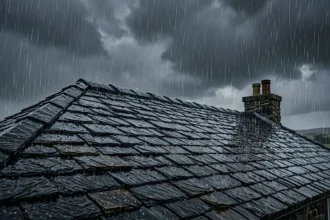
Then there is the Irish climate, which adds another layer of complexity to the mix. Heavy rain, strong wind and occasional storms cause roofing materials to deteriorate faster. A roof that might last thirty years in a drier climate may need attention sooner in Ireland.Therefore the decision to repair or replace must take into account the particular conditions to which the roof has been exposed.
When Is Repair Worth It
If the damage is localized, the roof is relatively young and the underlying structure is sound, repair is often the right choice. The following scenarios are typical candidates for repair rather than replacement.
Localised Leaks and Isolated Damage
A leak that appears in a single location, particularly after a storm, is often the result of a localised failure. A cracked tile, a slipped slate or a damaged flashing around a chimney can allow water into the building without indicating that the roof itself is failing.In these cases, a repair is the most economical solution.
What is important is to determine precisely where the leak is coming from. Water can move along rafters and joists before it appears on a ceiling, making it difficult to find the entry point without a professional inspection.The roofer will follow the water’s path and fix what’s wrong.
Slipped or Broken Tiles and Slates
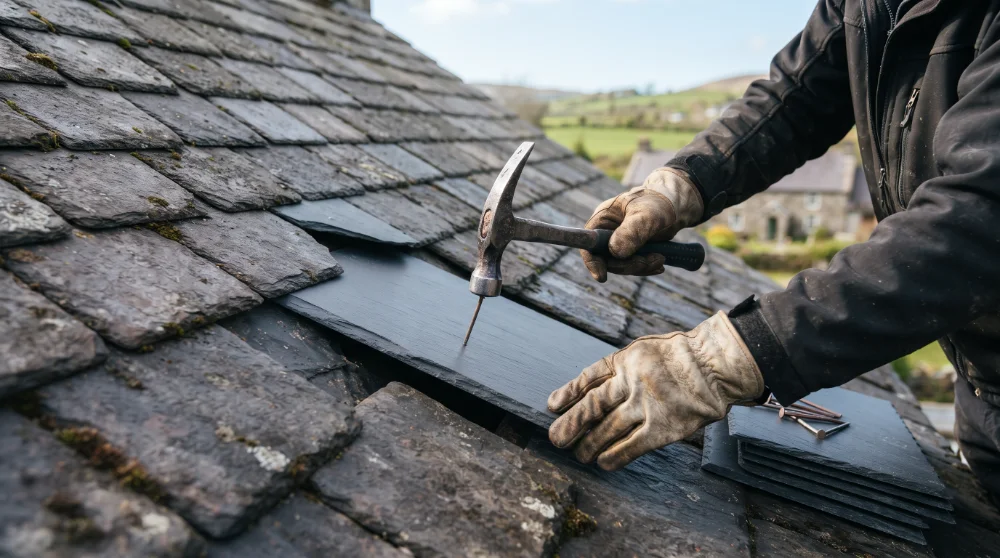
Individual tiles or slates can become dislodged by wind or damaged by impact. If the surrounding materials are in good condition, replacing the affected pieces is a straightforward repair. Price is reasonable and the roof can continue to perform well for many years.
It is important to fix slipped or broken tiles as soon as possible.Having an exposed roof area leaves you more susceptible to additional water intrusion. The extra exposure can weaken the materials around it.
Flashings and Seals Problems
Flashings are the pieces of metal or membrane that seal the joints between the roof and other parts of the building such as chimneys, walls, and valleys. It is a common point of failure especially in older properties where the original materials may have degraded.
Repairing or replacing flashings is generally less expensive than replacing the entire roof. If the roof covering itself is sound, new flashings can restore the roof’s watertightness and extend its serviceable life.
A Roof Under 20 to 25 Years Old
The expected lifespan of a well-installed roof depends on the material. Concrete tiles typically last forty to sixty years, clay tiles fifty years or more, and natural slate significantly longer. If the roof is less than twenty to twenty-five years old and the damage is limited, repair is almost always the more economical choice.
The exception is where the roof was poorly installed or where inferior materials were used. In these cases the roof may fail sooner than expected and replacement may be the only practical long-term solution.
If replacement is necessary
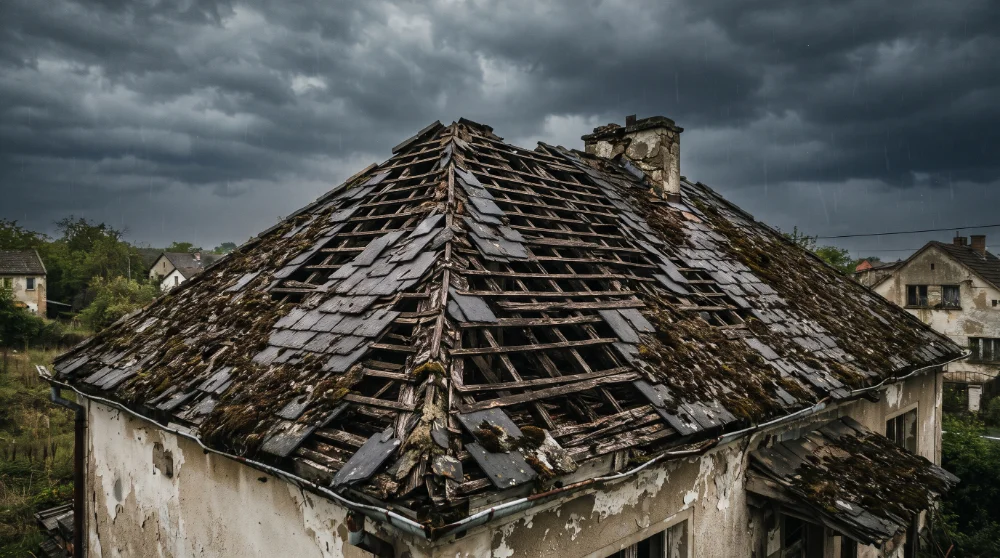
Replacement is the right call when your roof has reached the end of its serviceable life, when the damage is extensive or when the underlying structure has been compromised.The following signs indicate that it is no longer economical to repair.
Material Fatigue and End-of-Life
Every roofing material has a finite lifespan. As they age, they become brittle, lose their protective properties and are more likely to fail.A roof past its expected life span is going to be in need of constant repair and each repair is going to be a diminishing return on investment.
The signs of fatigue of materials are:
- Build-up of concrete or clay tile granules in gutters.
- Slates become brittle and easily cracked.
- Metal roofing showing signs of corrosion or rust.
- Widespread moss and lichen growth that has penetrated the surface.
When these signs are evident across the entire roof, replacement is the more economical long-term decision.
Multiple and Recurring Leaks
A single leak is a repair. Multiple leaks, or leaks that recur in different locations after being repaired, indicate that the roof as a whole is failing. Each new leak is a symptom of a larger problem. Fixing individual flaws is a game of diminishing returns.
Recurrent leaks can lead to cumulative damage to the interior of the building, such as staining, dampness, and potentially structural deterioration.It is often cheaper to eliminate the root cause by replacement than to manage the symptoms.
Structural Movement or Sagging
If a roof looks like it is sagging or seems to have structural movement it should be inspected by a professional immediately. Sagging can be a sign of weakened rafters or purlins due to moisture, rot or poor original construction. In these cases, repairing the surface covering is futile: the structural problem must be addressed first, and this often necessitates a full replacement.
Structural Deterioration and Rotten Wood
Once the roof covering is removed, the condition of the battens, felt and rafters can be seen. If the timber is rotting or infested with insects it will need replacing.In the worst cases, the structural integrity of the roof may be compromised and a full replacement may be the only safe option.
The outside does not always mean that there is rot.Sometimes you don’t find out until you open up the roof to repair it and then the extent of the work may balloon.
Repair vs. Replacement Cost Comparison
You need to understand what each option provides to be able to compare. The cost to repair and the cost to replace are on different scales.
Repair Cost
Typical repair costs in Ireland are:
- Replacement of a few broken tiles or slates: €200 to €600.
- ReInstallation or replacement of flashings around a chimney: €250-€600.
- Repairing a local leak: from €500 to €1,200.
- Fitting a piece of damaged roof covering – €1,000-€3,000.
These numbers are indicative and depend on access, location and how bad the damage is.Repairing a particular defect can restore the roof’s performance at a fraction of the cost of replacement.

The Cost of Replacements
A full re-roof is a huge expense. Indicative cost of a typical 3-bed semi-detached house in Ireland is between €8,000 and €18,000 for a concrete tile finish and between €12,000 and €28,000 for natural slate.These estimates include the cost of removing the existing roof, plus new materials and normal labor costs, but they do not include scaffolding, waste removal and repairs to the underlying structure.
When you replace your roof, you get a brand new, waterproof roof that will last for decades.It is also an opportunity to upgrade insulation, ventilation and flashings, which can increase the energy efficiency of the building and reduce future maintenance costs.
The Long-Term Calculation
Repair versus replacement cost shouldn’t be the only consideration. A €800 repair that adds five years to the roof’s lifespan might be better value than a €15,000 replacement, particularly if the homeowner plans to sell soon enough. Conversely, a series of repairs that cumulatively cost €5,000 over a short period, without resolving the underlying problem, may prove more expensive than a replacement that delivers decades of service.
The relevant calculation is the cost per year of serviceable life. A repair that costs €800 and lasts five years costs €160 per year. A replacement that costs €15,000 and lasts forty years costs €375 per year, but delivers a new roof with no further maintenance costs for decades.
The Importance of Professional Assessment
The decision to repair or replace should not be made on the basis of a visual inspection from ground level. A qualified roofing contractor will go through the roof methodically, looking at the condition of the covering, the flashings, the underlayment and the structure underneath.This assessment may require access to the roof and in some cases the opening up of sections of covering to inspect the timber underneath.
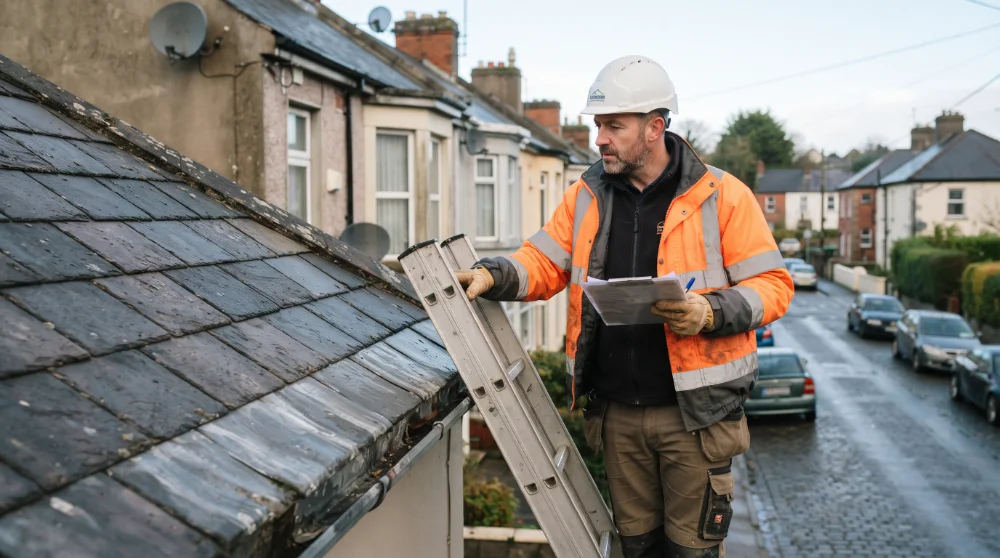
A professional assessment should give you:
- A specific defect identification.
- An explanation of the cause of the defects.
- A recommendation on whether repair or replacement is appropriate.
- A written, itemised quote for the recommended work.
Homeowners should obtain more than one assessment where possible, particularly for a replacement project. It’s a way to catch unnecessary work and make sure the contractor you choose is capable and honest. Compare quotes and recommendations.
Watch: A Comprehensive Property Roofing Guide
If you are weighing the long-term pros and cons of roof interventions, watching a structured expert breakdown can clarify your next steps. For a deeper visual walkthrough of what professional assessments entail, we recommend watching the guide:
At, the overview highlights how structural evaluations and preventative maintenance schedules help property owners avoid surprise repair bills, offering valuable context on when minor interventions stop making financial sense.
Questions to ask yourself before you decide
Homeowners should ask these questions before deciding whether to repair or replace:
- How old is the roof?This provides an indication as to whether the materials are approaching the end of their service life.
- How much damage is there? Is it confined to one area or is it more general?
- What is the condition of the underlying structure? Has the timber been inspected for rot or insect damage?
- What is the expected lifespan of the repair? A repair that lasts two years is a different proposition from one that lasts ten.
- What is the cost per year of serviceable life? This calculation provides a more meaningful comparison than the upfront cost alone.
- What is the long-term plan for the property? A homeowner planning to sell in the near term may choose a different path from one intending to remain for decades.
Conclusion
The decision to repair or replace a roof in Ireland is not a simple one, but it can be made systematically. Repair is appropriate when the damage is localised, the roof is relatively young, and the structure is sound. Replacement is the correct choice when the materials have reached the end of their service life, when the damage is widespread, or when the underlying structure has been compromised.
Each option carries major financial implications and the choice should be made on the basis of a professional assessment, a clear understanding of the costs and a realistic view of the long-term plan for the property. A well maintained roof is one of the most important investments a homeowner can make and the decision of repair or replacement should be made with the same care and diligence as any other major financial decision.